
| Issue | 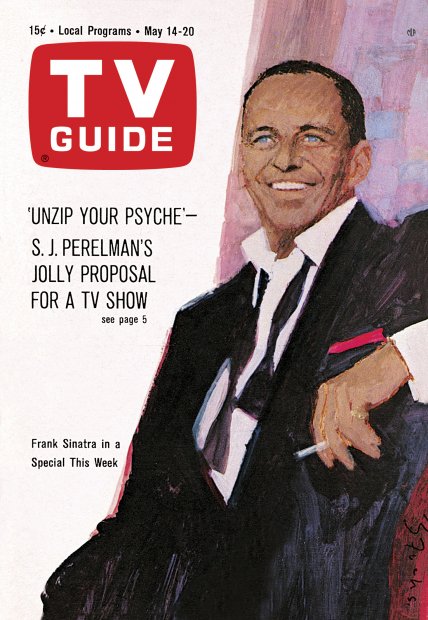 | |
|---|---|---|
| #685 | ||
| Type | ||
| Features | ||
| Author | ||
| TV Guide Staff | ||
| Letters | ||
| No Letters | ||
| Published | May 14, 1966 | |
| Issue Scans | Northern California | |
That van's out front again
Picture this scene: The happy family gathered in the cozy living room around the television set. Suddenly a knock on the door. Terror! Father leaps out of the easy chair and switches off the set. His frightened sons rush to shove the bureau in front of it. Sister and Mother grab for their knitting. Then Father wipes his sweating hands and fearfully opens the front door.
Hitler's Germany? Mussolini's Italy?
No, Queen Elizabeth's Britain. And we are looking at the home life of a television tax dodger when he knows a television-detection truck is somewhere in the neighborhood.
In Britain, in order to watch television on your own set without breaking the law, you must buy an annual license for five pounds ($14). Some 13,250,000 people faithfully do this and thus provide the funds that run the British Broadcasting Corporation.
But the law does not compel a buyer to prove he has a license before he can buy a set. So any number of otherwise honest citizens--the official estimate is 3,000,000--sneak their sets home and cackle illegally at Bob Hope or suffer unlawfully with Peyton Place under roofs innocent of telltale outdoor antennas.
In this case, as in thousands of others, Father wasted his time. For the man from the Post Office (which has the duty of collecting the fees for the BBC) said sternly: "Sir, our electronic equipment has told us exactly where your set is located. Yours is in the left corner of this room, behind that bureau, and you have just been watching Perry Mason."
Well, this being democratic Britain, the culprit generally confesses and gets a chance to pay his five pounds on the spot, after which all will be forgiven. If he argues, the Post Office man uses the aren't-you-ashamed-ofyourself gambit: "You wouldn't cadge a drink would you? Or ask your neighbor for money to go to the films? Then why do you watch television at the expense of your friends?"
If this fails, and the unrepentant viewer does not react to a final "Come on, sir. Be a good sport and pay up!" the Post Office calls in what its spokesman described to me as "the heavy hand of the law." This means a warrant for (a) illegally installing equipment capable of receiving a wireless-telegraphy signal and (b) using it.
The judge usually levies a fine of from 10 pounds ($28) to 50 ($140) and sometimes confiscates the set as well, in the case of hard-core addicts who can't kick the tax-evasion habit.
The license situation is just one of the problems of trying to run a television network as a public service, which is what the BBC is supposed to do under its Royal Charter from the Queen. The BBC is nearly $23,000,000 in debt, but it probably would not have to borrow from the banks at all if the reluctant 3,000,000 would pay the $42,000,000 in license fees they are now getting away. with. The Post Office, well aware of this vexing situation, has an intensive campaign under way, with television-detection trucks, equipped with huge revolving aerials, prowling the land.
These electronic marvels have the bootleg viewers really worried. When the Post Office discovered, for example, that in an entire year the town of Ipswich (pop: 120,000) had taken out only 250 new licenses, it sent one of the detector trucks boldly into the main street. The word spread like wildfire and some 1500 more people promptly paid up. In a group of eight cities and towns only 853 new licenses were issued last year. After the television trucks arrived, 6000 set owners rushed to make their peace with the BBC.
"Please make clear that we avoid Gestapo techniques," said a Post Office spokesman. "Our procedure goes like this: We determine what program the illegal set is tuned to. It's a psychological advantage to be able to knock on the door and say, ‘I hope you are enjoying The Flintstones, sir?' Generally they realize the game is up and they pay up and we say no more. But we will go to court if we have to. We are determined the 13,250,000 who pay should not have to support the 3,000000 who do not."
Last year the Post Office hauled 22,000 people into court. It credits publicity with shaming or frightening 283,000 others into digging down. The commercial television system, Independent Television (ITV), does not have to worry about licenses. It makes a fat annual profit from commercials. It would be even fatter if it had more broadcasting time (networks are limited to 50 hours a week by the Postmaster General). Consequently, it is constantly agitating for longer hours and for permission to go into color immediately. The BBC, chronically in hock with its public service commitments to provide two television channels and three radio networks, will go into colorcasting in the fall, despite financial difficulties. Norman Collins, one of the chief executives of commercial television, has suggested scrapping the license fees and giving the BBC an annual government grant instead. He said Britain--which had the world's first television service in 1936--is now a second-rater with three channels against seven for New York, seven for Tokyo and four for Sydney, Australia. "Also," he said dryly, "I do not have to remind you that New Yorkers have 200 hours of color every week and we have none."
Sir Hugh Carleton Greene, the able director general of the BBC, is afraid a government grant would erode the cherished independence of the organization. He would like to see the license fee raised to six pounds ($16.80) a year, but any government would regard this as political dynamite.
Because the public has its money in the BBC, one thing Sir Hugh gets is plenty of free advice. It's practically a national pastime. Not all of it is altruistic; and friends of the BBC, proud of its record in serious political and social criticism and its willingness to let its programs mock The Establishment of which it is itself a part, have to be on constant guard. As one influential newspaper (The Guardian) pointed out after persistent attacks in Parliament on BBC "immorality," the BBC stands in the way of further rich pickings from commercial TV and radio.
There are other problems that must make Sir Hugh wonder why he didn't become a novelist like his brother, Graham Greene. Have you ever heard of class-conscious viewing? They have it in Britain. A majority of the middle and upper classes watches the BBC. But the working class—and it represents 70 percent of the population—is mostly glued to the commercial stations, so the BBC starts from behind in the rating game, which it regrettably feels forced to play from time to time. Why do the viewers divide along class lines? No one seems to know. But a British housemaid offered a clue: She said the commercials often featured people just like herself.
If you still want to run a public-service network after the foregoing, consider this: Some time ago TV Guide asked a number of distinguished observers what kind of network they would set up if they had the opportunity. This was, of course, an exercise in fantasy, for none of the contributors would ever have to meet the challenge of putting his ideas into practice. But the BBC did just that in reality. It started from scratch three years ago to organize the best possible network that would serve as an alternative to the viewing fare already available.
The new network--BBC-2 by name--opened for business April 20, 1964. After some teething trouble it now has some of the best programs on television, an admirable blend of catering to the majority while not neglecting the minority. Critics often applaud its plays and documentaries and, especially, its nightly Late Night Lineup, in which the programs of the evening are discussed and argued over while still fresh in viewers' minds.
You can't please everybody, but in general the creators of BBC-2 did a good job, and within limits it may be said to have everything a network needs.
Except an audience!
Out of 26,000,000 potential viewers it manages, according to unofficial figures, a nightly average of under 150,000. Some nights this is even said to dip to 30,000 or 40,000 homes.
The BBC stoutly maintains that its second network (UHF) program still cannot be received in some areas of the nation and its audience is bound to grow. True, but the moral thus far makes a sad postscript to the TV Guide series, "As They See It":
You can lead your viewers to a better television service, but you can't make them switch on.