
| Author |  |
|---|---|
| Richard M. Levine | |
| Issue | |
| Issue #1470 (May 30 '81 - Jun 05 '81) |
| Article Scans | |||
|---|---|---|---|
 |
 |
 |
 |
| 1 | 2 | 3 | 4 |
| ↑ Part 1 | Part 2 → |
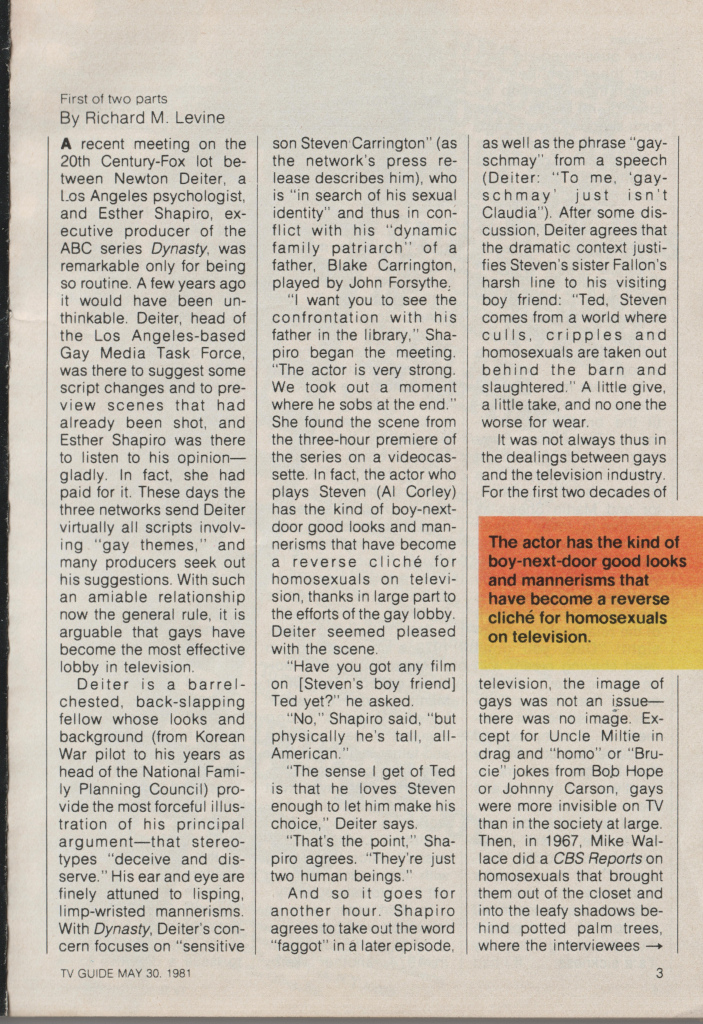
A recent meeting on the 20th Century-Fox lot between Newton Deiter, a Los Angeles psychologist, and Esther Shapiro, executive producer of the ABC series Dynasty, was remarkable only for being so routine. A few years ago it would have been unthinkable. Deiter, head of the Los Angeles-based Gay Media Task Force, was there to suggest some script changes and to preview scenes that had already been shot, and Esther Shapiro was there to listen to his opinion--gladly. Infact, she had paid for it. These days the three networks send Deiter virtually all scripts involving "gay themes," and many producers seek out his suggestions. With such an amiable relationship now the general rule, it is arguable that gays have become the most effective lobby in television.
Deiter is a barrel-chested, back-slapping fellow whose looks and background (from Korean War pilot to his years as head of the National Family Planning Council) provide the most forceful illustration of his principal argument--that stereotypes "deceive and disserve." His ear and eye are finely attuned to lisping, limp-wristed mannerisms. With Dynasty, Deiter's concern focuses on "sensitive son Steven Carrington" (as the network's press release describes him), who is "in search of his sexual identity" and thus in conflict with his "dynamic family patriarch" of a father, Blake Carrington, played by John Forsythe.
I want you to see the confrontation with his father in the library, "Shapiro began the meeting." The actor is very strong. We took out a moment where he sobs at the end." She found the scene from the three-hour premiere of the series on a videocassette. In fact, the actor who plays Steven (Al Corley) has the kind of boy-next-door good looks and mannerisms that have become a reverse cliche for homosexuals on television, thanks in large part to the efforts of the gay lobby. Deiter seemed pleased with the scene.
"Have you got any film on [Steven's boyfriend] Ted yet?" he asked.
"No," Shapiro said, "but physically he's tall, all-American."
"The sense I get of Ted is that he loves Steven enough to let him make his choice," Deiter says.
"That's the point," Shapiro agrees. "They're just two human beings."
And so it goes for another hour. Shapiro agrees to take out the word "faggot" in a later episode, as well as the phrase "gay-schmay" from a speech (Deiter: "To me, 'gay-schmay' just isnt Claudia"). After some discussion, Deiter agrees that the dramatic context justifies Steven's sister Fallon's harsh line to his visiting boy friend: "Ted, Steven comes from a world where culls, cripples and homosexuals are taken out behind the barn and slaughtered. "A little give, a little take, and no one the worse for wear.
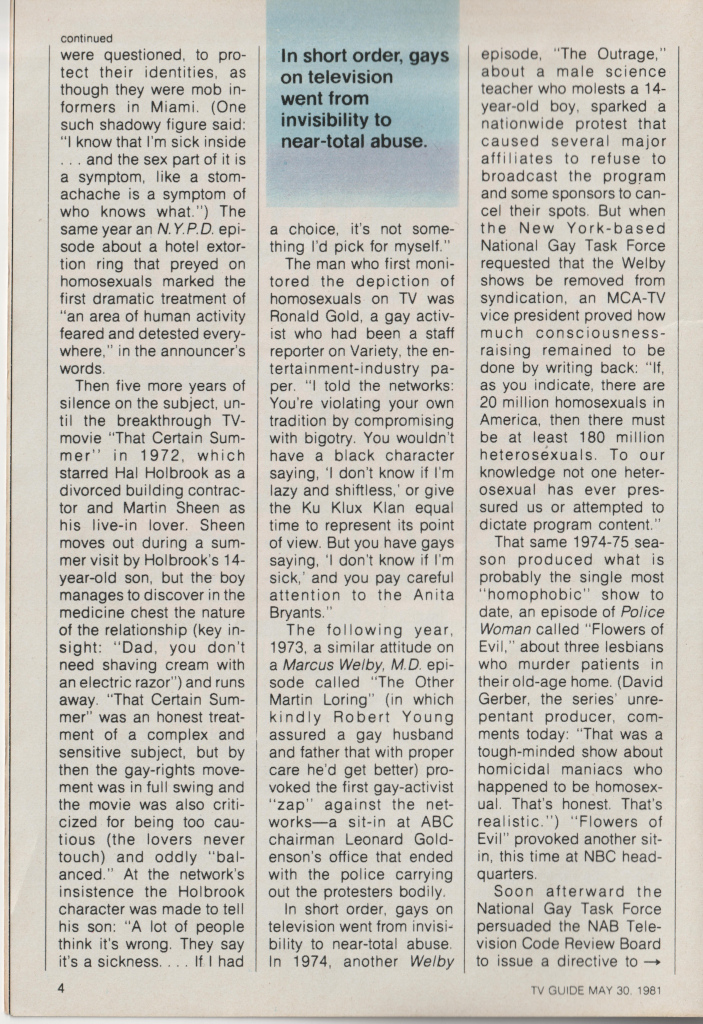
It was not always thus in the dealings between gays and the television industry. For the first two decades of television, the image of gays was not an issue--there was no image. Except for Uncle Miltie in drag and "homo" or "Brucie" jokes from Bob Hope or Johnny Carson, gays were more invisible on TV than in the society at large. Then, in 1967, Mike Wallace did a CBS Reports on homosexuals that brought them out of the closet and into the leafy shadows behind potted palm trees, where the interviewees were questioned, to protect their identities, as though they were mob informers in Miami. (One such shadowy figure said: "I know that I'm sick inside...and the sex part of it is a symptom, like a stomachache is a symptom of who knows what.") The same year an N.Y.P.D. episode about a hotel extortion ring that preyed on homosexuals marked the first dramatic treatment of "an area of human activity feared and detested everywhere," in the announcer's words.
Then five more years of silence on the subject, until the breakthrough TV movie “That Certain Summer" in 1972, which starred Hal Holbrook as a divorced building contractor and Martin Sheen as his live-in lover. Sheen moves out during a summer visit by Holbrook’s 14-year-old son, but the boy manages to discover in the medicine chest the nature of the relationship (key insight: "Dad, you don't need shaving cream with an electric razor") and runs away. "That Certain Summer" was an honest treatment of a complex and sensitive subject, but by then the gay rights movement was in full swing and the movie was also criticized for being too cautious (the lovers never touch)and oddly "balanced." At the network's insistence the Holbrook character was made to tell his son: "A lot of people think it's wrong. They say it's a sickness... If I had a choice, it's not something I'd pick for myself."
The man who first monitored the depiction of homosexuals on TV was Ronald Gold, a gay activist who had been a staff reporter on Variety, the entertainment industry paper. "I told the networks: You're violating your own tradition by compromising with bigotry. You wouldn't have a black character saying, "I don’t know if I'm lazy and shiftless," or give the Ku Klux Klan equal time to represent its point of view. But you have gays saying, "I don't know if I'm sick," and you pay careful attention to the Anita Bryants."
The following year, 1973, a similar attitude on a Marcus Welby, M.D. episode called "The Other Martin Loring" (in which kindly Robert Young assured a gay husband and father that with proper care he'd get better) provoked the first gay activist "zap" against the networks--a sit in at ABC chairman Leonard Goldenson's office that ended with the police carrying out the protesters bodily.
In short order, gays on television went from invisibility to near total abuse. In 1974, another Welby episode, "The Outrage," about a male science teacher who molests a 14-year-old boy, sparked a nationwide protest that caused several major affiliates to refuse to broadcast the program and some sponsors to cancel their spots. But when the New York based National Gay Task Force requested that the Welby shows be removed from syndication, an MCA-TV vice president proved how much consciousness-raising remained to be done by writing back: "If, as you indicate, there are 20 million homosexuals in America, then there must be at least 180 million heterosexuals. To our knowledge not one heterosexual has ever pressured us or attempted to dictate program content."
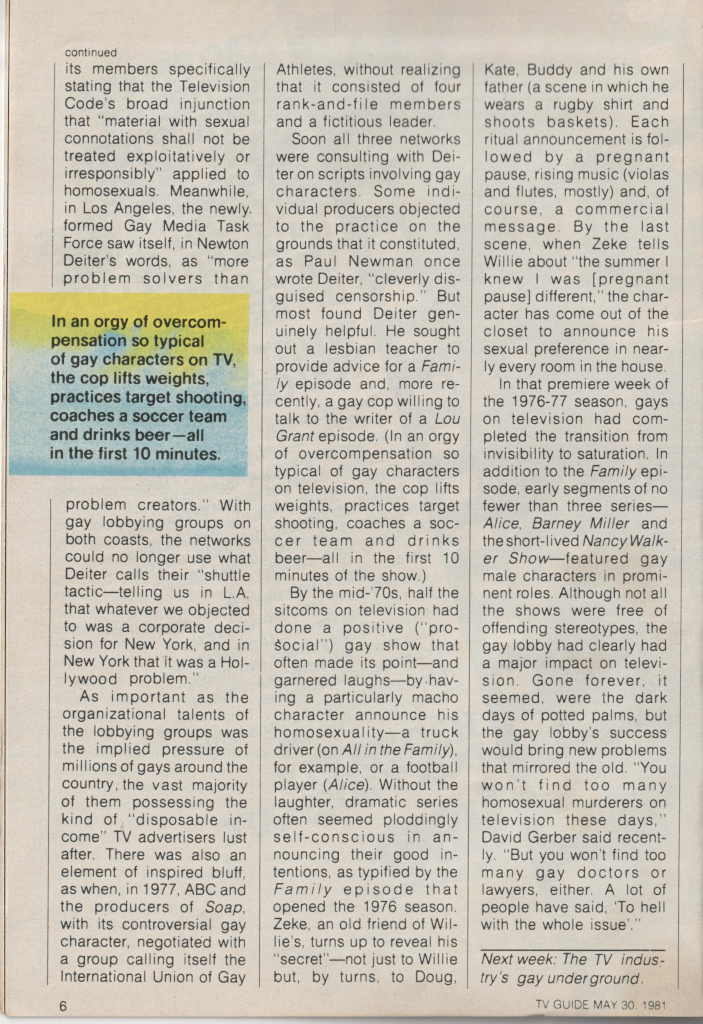
That same 1974-75 season produced what is probably the single most "homophobic" show to date, an episode of Police Woman called "Flowers of Evil," about three lesbians who murder patients in their old age home. (David Gerber, the series' unrepentant producer, comments today: "That was a tough-minded show about homicidal maniacs who happened to be homosexual. That's honest. That's realistic.") "Flowers of Evil" provoked another sit-in, this time at NBC headquarters. Soon afterward the National Gay Task Force persuaded the NAB Television Code Review Board to issue a directive to its members specifically stating that the Television Code's broad injunction that "material with sexual connotations shall not be treated exploitatively or irresponsibly" applied to homosexuals. Meanwhile, in Los Angeles, the newly formed Gay Media Task Force saw itself, in Newton Deiter's words, as "more problem solvers than problem creators." With gay lobbying groups on both coasts, the networks could no longer use what Deiter calls their "shuttle tactic--telling us in L.A. that whatever we objected to was a corporate decision for New York, and in New York that it was a Hollywood problem."
As important as the organizational talents of the lobbying groups was the implied pressure of millions of gays around the country, the vast majority of them possessing the kind of "disposable income" TV advertisers lust after. There was also an element of inspired bluff, as when, in 1977, ABC and the producers of Soap, with its controversial gay character, negotiated with a group calling itself the International Union of Gay Athletes, without realizing that it consisted of four rank-and-file members and a fictitious leader.
Soon all three networks were consulting with Deiter on scripts involving gay characters. Some individual producers objected to the practice on the grounds that it constituted, as Paul Newman once wrote Deiter, "cleverly disguised censorship." But most found Deiter genuinely helpful. He sought out a lesbian teacher to provide advice for a Family episode and, more recently, a gay cop willing to talk to the writer of a Lou Grant episode. (In an orgy of overcompensation so typical of gay characters on television, the cop lifts weights, practices target shooting, coaches a soccer team and drinks beer--all in the first 10 minutes of the show.)
By the mid-'70s, half the sitcoms on television had done a positive ("pro-social") gay show that often made its point--and garnered laughs--by having a particularly macho character announce his homosexuality--a truck driver (on All in the Family), for example, or a football player (Alice). Without the laughter, dramatic series often seemed ploddingly self-conscious in announcing their good intentions, as typified by the Family episode that opened the 1976 season. Zeke, an old friend of Willie's, turns up to reveal his "secret"--not just to Willie but, by turns, to Doug, Kate, Buddy and his own father (a scene in which he wears a rugby shirt and shoots baskets). Each ritual announcement is followed by a pregnant pause, rising music (violas and flutes, mostly) and, of course, a commercial message. By the last scene, when Zeke tells Willie about "the summer I knew I was [pregnant pause] different, "the character has come out of the closet to announce his sexual preference in nearly every room in the house.
In that premiere week of the 1976-77 season, gays on television had completed the transition from invisibility to saturation. In addition to the Family episode, early segments of no fewer than three serie--Alice,Barney Miller and the short-lived Nancy Walker Show--featured gay male characters in prominent roles. Although not all the shows were free of offending stereotypes, the gay lobby had clearly had a major impact on television. Gone forever, it seemed, were the dark days of potted palms, but the gay lobby's success would bring new problems that mirrored the old. "You won't find too many homosexual murderers on television these days," David Gerber said recently." But you won't find too many gay doctors or lawyers, either. A lot of people have said, 'To hell with the whole issue'.
| ↑ Part 1 | Part 2 → |