
| Author | 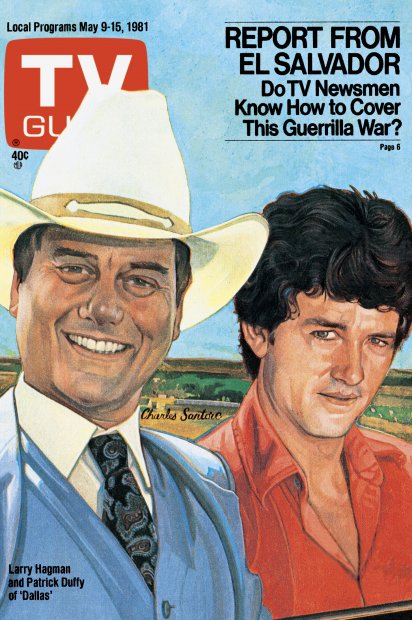 |
|---|---|
| Ellen Torgerson Shaw | |
| Issue | |
| Issue #1467 (May 09 '81 - May 15 '81) |
Scene I:
The Bel-Air Hotel. Finely tuned snooty. Polite snubs. A small glass of orange juice, fresh-squeezed five hours ago, is two dollars. The waitress demands payment before breakfast is over. All of this amuses Patrick Duffy. who used to deliver floral arrangements at the back door some six years ago. He smiles at the memory of back doors. Since then, of course, he's struck gold in CBS's Dallas, playing one of the more lovable members of the Ewing dynasty, good prince Bobby.
The dining room in the Bel-Air Hotel is three-quarters empty today, and no one recognizes Duffy. He is clad in comfortably aged jeans, a light-blue T-shirt with two tiny holes in its left sleeve and a belt cinched in a monumental turquoise-and silver buckle. His clothing speaks of his past and his present: once a poor man, now a rich man. A man who's made it and does not disdain that fact....
Scene II:
A designer-furniture boutique. Out front sits Duffy's chic new blue-and-white Jeep. He leaves the second-hand, 11-year-old Mercedes for his wife. It's an easier car to drive with a 14-month-old boy and a 6-year-old boy in tow. In times gone by, Duffy made his living as a carpenter, so he opens doors to cabinets in the boutique today. Lovingly, he runs his hand over a chest covered in goatskin and lacquered to a sunstruck gleam. He wanders to a chair whose arms end in sculptured swans' heads. "My wife loved this last time we were in," he says. Maybe, someday, I'll buy it for her." It is $2000.
The owner of the shop, hovering helplully, says suddenly, "Hey, aren't you in Dallas?" Courteously, Duffy nods. Sevenleen minutes of gush and thrill ensue. As Duffy leaves, the owner calls out after him, "We'll do the chair in any color or size you want."
Scene III:
Michael's, a restaurant in Santa Monica. Nouvelle cuisine and the patronage of the nouveaux riches, even the anciens riches. Riches galore. Duffy and his wife of 10 years, Carlyn, drift in. Duffy is dressed in a bold plaid jacket and a tie slightly askew. Clothes, he says, are something he never thinks about much. The conversation centers on beginnings, on careers. "I wasn't a good dancer," says Carlyn, who is bright, pretty, Dutch-girl blonde, "but I was persistent." A ballerina for 20 years, starting when she was 15, Carlyn says, "I had a career; I'm having a family now."
Both gaze raptly at the elaborate menu. In the early days of their relationship. Carlyn cooked spinach-cheese-and-rice casseroles on a hot plate. During that time, Duffy worked as a waiter: "Everyone would collect all the edibles off the plates and put them in a sack for me to take home.
But Duffy was always certain he'd be wealthy and worshiped. Famous, too. "I never doubted I'd be in this position," he says. "I was always confident." And why not? He was brought up to be that way, as the only boy Duffy in a family that included many admiring aunts, uncles and cousins-to say nothing of his adoring parents.
A very small-town boy, Duffy was born in Townsend, Mont., 32 years ago. His parents, Terence and Marie, owned a tavern. "I looked up to my father a lot. He was very handsome, the center of attention. It was his bar; he controlled the conversation and ruled the roost," Duffy recalls. "I wanted to be just like him. I thought I was going to be a bartender."
There was a gypsy strain in the braw Terence. In search of adventure, he had packed up his wife and children (Patrick was 3; his older sister, 5) and taken off for Alaska with another family. They stayed for two years. "While they waited for work [Terence is also a carpenter] they played cribbage, and we lived on the eight-dozen eggs we brought with us," Duffy says. When Patrick was 5, the family went back to Montana. But Terence's wanderlust returned and the Duffys went to Seattle to seek another way of life. "Bartending," says Duffy, "is hard on a person's health." This time, Patrick was 13 and the Seattle experience changed him. "It got me out of the smalltown syndrome," he says. "Whoa, there's a lot more to life than I thought."
But in Seattle the Duffy finances did not improve--excellent training for the starving actor-to-be. "We were exceptionally poor. I earned all my money for clothes," says Duffy. "I worked as a mechanic in a garage. I like anything physical. I would have been happy as a bricklayer."
Duffy knew he could be a bartender. Hе knew he could be a carpenter. He knew he could be a mechanic. What he didn't know was that he could be an actor. Indifferent to school, he didn't study, got B's and only came alive performing in plays. "In the drama department was a lady who said acting was a respectable profession and I could make a living at it. From the time I graduated from high school I went headlong into acting."
Accepted at the University of Washington's drama school, Duffy delightedly learned his craft. "Nothing was required of us but acting." No math. No Chaucer. No dissecting preserved frogs.
At 6-feet-2, 185 pounds, Duffy is a man with a "strong constitution." He never gets sick, he says. Except for one dreadful time. Duffy was in class from 9 A.M. to 5 P.M. daily. "Then we took a break for supper and went on with the evening production." After the curtain dropped, Duffy would hustle to his janitorial job in a hospital 20 miles away. "I'm not sure I ever slept at all," he says. He was felled by laryngitis and advised to rest his voice. Not the sort to heed such warnings, Duffy ruptured his vocal chords. "I graduated without a voice," he says. Told by a doctor he'd have to be quiet for a couple of months or voiceless forever, Duffy resigned himself to not speaking. "I wrote notes and whistled on the phone."
Along came Carlyn. "She came through [Seattle] in a ballet group. In the dance company were five women. I thought, my God, pig heaven. I'll work my way through, starting on the left." First on the left was Carlyn. "I fell crazy in love and forgot the rest."
Not only was Carlyn his introduction to the art of togetherness (10 years married, they still hold hands at the dinner table and turn to each other for confirmation), but she led Patrick to Buddhism, in which they strongly believe and which they practice still. When Duffy must move to Dallas for three months to film the series, Carlyn and their sons go with him, rent a house and continue family life.
It was Carlyn who urged Patrick to try his luck in New York. He did, and waited on tables and carpentered. His talents as a carpenter were in demand; his gifts as an actor were not. Several years later, a part in an off-Broadway play, "Natural Affection," got him an agent to whom he is still loyal: "I came to L.A. in 1974; I didn't work for three years. She could have dropped me, but she didn't."
In 1977 Patrick got the lead in NBC's science-fiction series Man from Atlantis; he swam a lot and wore webbed feet and hands, and special lenses that hurt his eyes. Luckily, the show was canceled before he lost his eyesight or became permanently wrinkled head to toe from all the underwater soaking. A week later, Duffy tested for Dallas and was chosen from among 12 candidates because "he fit the part-charming, handsome, open," according to Leonard Katzman, Dallas producer.
But about five shows into the series' first full season, Duffy grew discontented with Bobby. Boring, boring, boring. Being the same sweet, nice Bobby everybody dumps on, while that cad J.R. gets all the acting goodies. This is not a case of intramural jealousy--Duffy and Larry Hagman are friends on and off the set.
Thus Duffy sallied into the office of producer Katzman armed with complaints. "I told him: 'It's not what I will do. You gotta give this man chinks, allow him to fail, pick himself back up'." Soothing stars is Katzman's job. He proceeded to do so. This year's scripts were devoted to what Duffy calls "the corruption of an honest man." So for about 10 episodes, Bobby Ewing got meaner 'n crabgrass. "But then I gave the Ewing empire back to J.R." Since then Bobby has been-in the words of Mad magazine-"Booby" Ewing. Duffy professes not to care all that much. "I've stopped really being that concerned. I'm concentrating on developing other parts of my career [theatrical films, TV-movies and directing]. Dallas is now an enjoyable income tool."
And how is Duffy regarded by the others in Dallas?
Victoria Principal, who plays Pam, Bobby's wife, in the series, predictably says: "He's very professional, unusually bright and aware of his craft at all times." And Duffy's reaction to his co-workers? Well, he socializes with Hagman and with Steve Kanaly (who plays Ray Krebbs). Otherwise: "I enjoy all the Dallas cast as people; no, I do not get along with all of them. Let's say there are two categories--friendly and friendly-but-not-friendly. For the most part I respect everyone; don't necessarily respect their talent, but I do respect them as people." Duffy changed his viewpoint several months later when he directed an episode of Dallas. "You know that friendly competition you get into when you're in a scene with somebody? Now I feel totally different." Indeed, Duffy feels quite saintly about everybody. "I'm breaking my goodliness record," he says, laughing.
For the rest of his life Duffy wants to act and direct. Gradually, he says, he'll turn character actor. For now he's the stuff of romantic leads. He doesn't mind. Part of his good fortune is his good looks.
In his time, Duffy has caused near-cardiac arrest in many a woman. That undifferentiated lust he arouses is part of his star appeal and he is well-aware of it. It dazzled him for a while. "In few professions do you go from obscurity to where so many people are telling you you're great. There's a dichotomy between why you're so ordinary one minute and now so suddenly terrific. Then you're swamped with temptations. My family life had a potential to become secondary," he says. "I never had notoriety before. I was taken with it. Then I realized my family was the reason I was where I was. From then on it was A-OK."
Right. Now that he's turned Ewing Oil over to J.R. and Daddy Ewing, all he has to worry about is lining up one film after another during his four-month-long hiatus.
Striking while the iron is blazing is the Duffy code... and the Duffy mode.